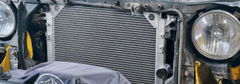
Radiator for Buick Allure LaCrosse 2005-2008 3.6L, Chevy Impala 2006-2011 3.5L 3.9L, Monte Carlo 2006-2007, Replace CU2827 10344419 BDFHYK
Regular price
$98.33
Product Detail
- Type Radiator
- SKU BDDLZ-BD-05-07794
- OE Number
Estimated Delivery:
Calculating...
·
Ships by
Calculating...
·
Free Shipping
Trust & Assurance
Free Shipping · 2–7 Business Days
12-Month Warranty
30-Day Return
Secured Payment
Restore stable engine cooling with this direct-fit replacement radiator for select Chevrolet Impala, Chevrolet Monte Carlo, and GMC Acadia models. Built with an aluminum core and OE-style mounting points, it is designed to replace a leaking, clogged, corroded, or damaged factory radiator and help maintain proper engine operating temperature during daily driving, city traffic, highway use, and warm-weather operation.
Vehicle Fitment & OE Reference Numbers
| Vehicle | Years | Engine |
|---|---|---|
| Chevrolet Impala | 2006-2011 | Verify by vehicle configuration |
| Chevrolet Monte Carlo | 2006-2007 | Verify by vehicle configuration |
| GMC Acadia | 2007-2011 | Verify by vehicle configuration |
OE / Interchange Reference Numbers: CU2827, 2827, DPI 2827, 10344419, GM3010484.
Before ordering: Compare the OE number, overall dimensions, inlet and outlet positions, mounting points, drain location, and fan shroud mounting configuration with the original radiator.
Product Specifications & Package Includes
| Product Type | Engine Coolant Radiator |
|---|---|
| Core Material | Aluminum |
| Installation Type | Direct OE-style replacement |
| Leak Testing | Pressure and leak tested before shipment |
Package Includes: 1 × replacement radiator.
Signs Your Radiator Needs Replacement
- The engine temperature runs higher than normal or the vehicle overheats.
- Coolant leaks appear around the radiator, end tanks, hose connections, drain area, or lower corners.
- The coolant level drops repeatedly without an obvious hose leak.
- Plastic end tanks are cracked, swollen, discolored, or separating from the core.
- Cooling fins are bent, clogged, corroded, or damaged.
- The temperature gauge fluctuates during city driving, idling, or warm-weather use.
Replacing a worn or damaged radiator helps restore coolant flow and heat transfer, reducing the risk of repeated overheating and related engine damage.
Key Features & Benefits
Direct OE-Style Replacement: Designed around factory-style mounting locations and hose connections for compatible Chevrolet and GMC applications.
Aluminum Core Construction: The aluminum core supports efficient heat transfer while remaining lightweight and corrosion resistant.
Stable Daily Cooling: Helps maintain engine temperature during commuting, stop-and-go traffic, highway driving, idling, and warm-weather operation.
Pressure & Leak Tested: Each radiator is tested before shipment to support dependable cooling-system performance.
Built for Replacement Service: Suitable for replacing radiators affected by leaks, internal blockage, damaged fins, corrosion, cracked tanks, or weakened seals.
Installation Notes & 4-Step Guide
Important: The cooling system may be pressurized and contain hot coolant. Allow the engine to cool completely before beginning. Professional installation is recommended if you are not experienced with cooling-system service.
- Drain: Disconnect the battery if required, remove the radiator cap only after the engine has fully cooled, and drain the old coolant into a suitable container.
- Remove: Disconnect the upper and lower radiator hoses, overflow hose, fan shroud or fan assembly, and factory mounting hardware. Remove the old radiator carefully.
- Install: Compare both radiators before fitting. Transfer reusable brackets, cushions, drain plugs, sensors, fittings, or fan shroud hardware when required, then install the new radiator using the factory mounting points.
- Refill & Bleed: Reconnect all hoses, refill with the vehicle manufacturer-recommended coolant mixture, bleed trapped air from the cooling system, and inspect all connections for leaks.
After installation: Inspect the radiator hoses, clamps, cap, thermostat, cooling fan, coolant reservoir, and water pump. Run the engine until operating temperature is reached, confirm fan operation, check all connections for leakage, and recheck the coolant level after the first drive and again after the engine cools.


Radiator for Buick Allure LaCrosse 2005-2008 3.6L, Chevy Impala 2006-2011 3.5L 3.9L, Monte Carlo 2006-2007, Replace CU2827 10344419 BDFHYK
Regular price
$98.33